
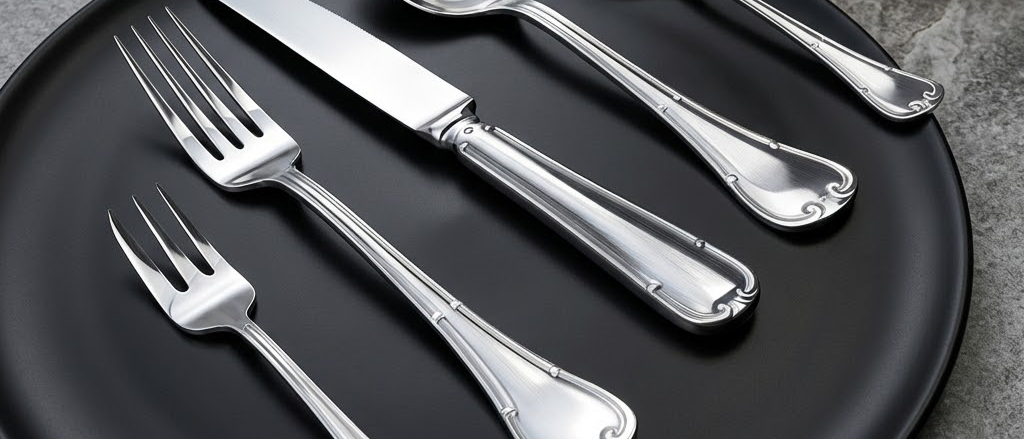
304 vs 316 Stainless Steel Flatware: Which One Should You Choose?
Not sure whether to choose 304 or 316 flatware? Compare composition, corrosion resistance, cost, lifespan, and best-use scenarios in this practical guide for home and restaurant buyers.
304 vs 316 Stainless Steel Flatware: Which Is Right for Your Restaurant or Home?
If you're buying flatware — whether for your home kitchen, your restaurant, or a hotel chain — you've probably faced this question: Should I choose 304 or 316 stainless steel?
The answer isn't as simple as "one is better." Each grade has specific strengths, and choosing the wrong one can mean either paying too much for features you don't need, or ending up with flatware that corrodes too quickly in your environment.
This guide breaks down the real, practical differences between 304 and 316 flatware — composition, durability, cost, and best-use scenarios — so you can make an informed decision.
What Makes Stainless Steel "Stainless"? A Quick Refresher
Stainless steel gets its rust resistance from chromium, which forms an invisible protective layer on the surface. When this layer is exposed to oxygen, it self-repairs. The difference between 304 and 316 comes down to additional alloying elements that enhance this protection in specific ways.
Think of it like a raincoat: 304 is a good quality standard raincoat. 316 is the same raincoat, but with an extra waterproof layer — essential if you live in a hurricane zone.
304 Stainless Steel: The Reliable Workhorse for Everyday Use
Also known as 18/8 stainless steel (18% chromium, 8% nickel), 304 is the most widely used grade in the world for food contact applications. It strikes an excellent balance between performance and cost.
| Feature | 304 Stainless Steel |
|---|---|
| Corrosion resistance | Excellent for daily food contact — water, mild acids, oils, coffee, tea |
| Formability | Can be shaped into any design — classic, modern, ornate |
| Cost | $ – Budget-friendly, especially for bulk orders |
| Maintenance | Easy to clean; dishwasher safe; stays shiny with basic care |
| Heat tolerance | Good for normal dishwashing and food temperatures |
| Durability | Lasts 10+ years with normal use in home or restaurant settings |
When to Choose 304 Flatware
- Home kitchens — daily family meals, occasional dinner parties
- Standard restaurants — casual dining, bistros, cafes
- Catering services — buffet events, corporate lunches
- Hotels — general dining, breakfast services
- Budget-conscious buyers — you want quality without overspending
For 90% of flatware buyers, 304 stainless steel is the perfect choice. It's safe, durable, and affordable — especially when sourcing in bulk from Glophee.
316 Stainless Steel: The Premium Choice for Tough Environments
Also known as 18/10 stainless steel with molybdenum (18% chromium, 10% nickel, 2–3% molybdenum). The addition of molybdenum is the key — it dramatically improves resistance to chlorides, salt, and acids.
| Feature | 316 Stainless Steel |
|---|---|
| Corrosion resistance | Superior — resists salt, bleach, chlorides, and strong acids |
| Formability | Good — slightly harder to shape, but still versatile |
| Cost | $$ – Higher due to molybdenum and nickel content |
| Maintenance | Same as 304 — easy to clean and dishwasher safe |
| Heat tolerance | Higher — withstands more heat without warping |
| Durability | Lasts 15–20+ years even in challenging environments |
When to Choose 316 Flatware
- Coastal restaurants — salt air accelerates corrosion of 304
- Cruise lines & marine venues — constant saltwater exposure
- Seafood restaurants — lemon, vinegar, and shellfish juices are highly acidic
- Medical and laboratory settings — sterilization and chemical resistance required
- High-end hospitality — premium image demands premium materials
Head-to-Head Comparison: 304 vs 316 at a Glance
| Criterion | 304 Stainless Steel | 316 Stainless Steel |
|---|---|---|
| Composition | 18% Cr, 8% Ni | 18% Cr, 10% Ni, 2–3% Mo |
| Price per unit (bulk) | $0.50 – $2.00 | $1.50 – $4.00 |
| Salt corrosion resistance | Good | ✅ Excellent (Mo makes the difference) |
| Acid resistance | Good (lemon, vinegar, tomato) | ✅ Excellent (handles stronger acids) |
| Dishwasher durability | ✅ Excellent | ✅ Excellent |
| Scratch resistance | Good | Better (slightly harder surface) |
| Lifespan (normal use) | 10+ years | 15–20+ years |
| Appearance | Bright, mirror finish | Slightly warmer tone, premium feel |
How to Decide: A Simple 3-Step Framework
Step 1: Assess Your Environment
- ❄️ Inland, dry climate? → 304 is perfect
- 🌊 Coastal, high humidity? → Consider 316
- 🍋 Heavy seafood/acidic food service? → 316 recommended
- 🏥 Medical or lab use? → 316 required
Step 2: Calculate Your Budget
- One-time purchase for home: 304 gives the best value
- Bulk buy for business (1000+ pieces): 304 saves 40–50% vs 316
- Marine/coastal business: 316 costs more upfront but lasts longer — lower total cost over 10 years
Step 3: Consider Your Brand
- 316 flatware has a perceptibly premium feel — slightly heavier, warmer in hand
- If your brand positions as luxury, 316 reinforces that message
- For cost-conscious brands, 304 offers excellent quality without premium pricing
Why Buy from Glophee?
At Glophee, we offer both 304 and 316 flatware in ready-to-ship bulk inventory. Here's what sets us apart:
- Certified materials — every batch tested for exact composition
- Competitive bulk pricing — factory-direct, no middlemen
- Fast lead times — ready-to-ship, not made-to-order
- Expert guidance — our team helps you pick the right grade for your needs
- Quality guarantee — strict inspection on every piece
Frequently Asked Questions
Does 316 stainless steel contain more nickel? Is that a problem?
Yes, 316 contains 10% nickel vs 8% in 304. This is not a health concern — nickel is fully alloyed into the steel structure and does not leach into food under normal use. Both grades are food-safe.
Can I tell 304 and 316 apart by looking?
Not reliably by eye alone. 316 may have a slightly warmer tone, but the difference is subtle. Always verify through manufacturer documentation or a material test kit.
Is 316 worth the extra cost for a home kitchen?
Generally, no. 304 is more than sufficient for home use. Unless you live in a coastal area or frequently cook with highly acidic foods, the extra cost of 316 is unnecessary.
Does Glophee carry both 304 and 316 flatware?
Yes. Browse our full selection to find the grade that fits your needs, or contact our team for bulk pricing on your preferred grade.
Bottom Line
Choosing between 304 and 316 flatware doesn't have to be complicated:
- Choose 304 — for everyday home use, standard restaurants, and most business needs. It's safe, durable, and cost-effective.
- Choose 316 — for coastal environments, seafood venues, medical settings, or when you need the absolute best corrosion resistance.
Either way, always buy from a verified manufacturer who provides clear material certification. Your flatware is an investment — choose wisely.
Ready to order? Shop Glophee's bulk flatware collection — factory-direct, quality guaranteed.