
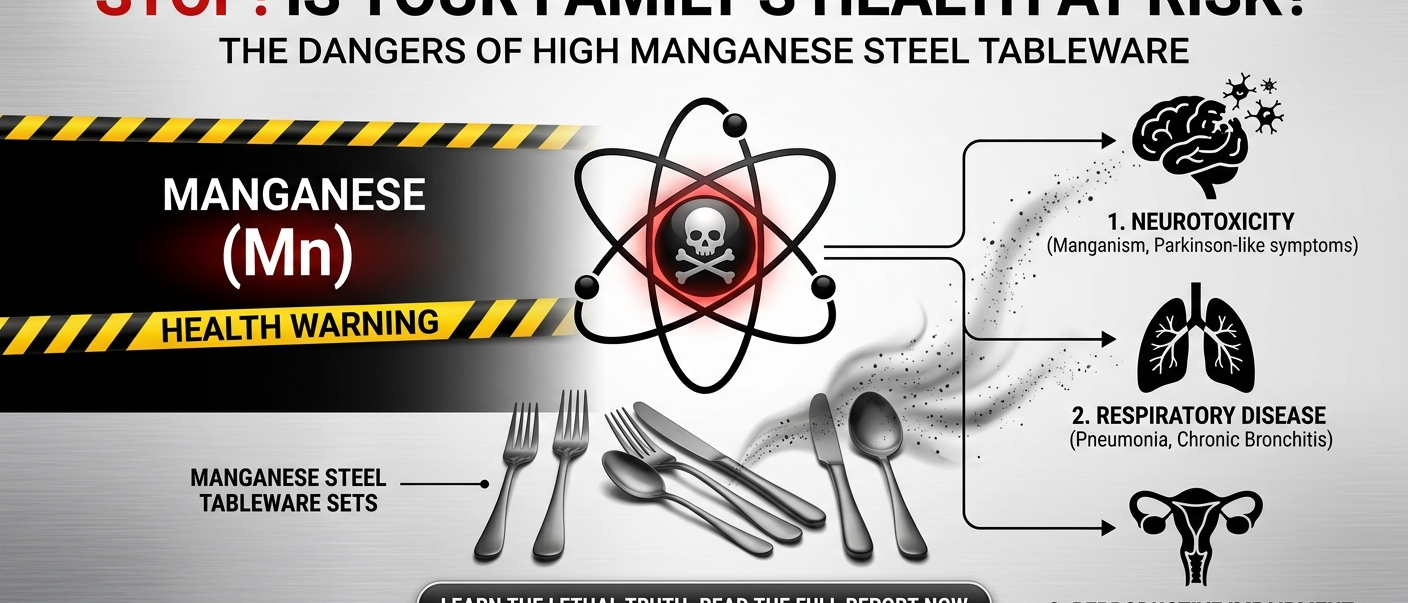
Is Your Cutlery Toxic? The Truth About High Manganese Steel Dangers
High manganese steel in cutlery can leach into food and cause serious health issues. Learn how to identify dangerous products, understand the science-backed risks, and choose safe 304 stainless steel alternatives.
Is Your Cutlery Making You Sick? The Truth About High Manganese Steel
When you pick up a fork or spoon, the last thing on your mind is whether it might be harming your health. But here's a disturbing reality: some stainless steel cutlery contains dangerously high levels of manganese that can leach into your food — and manufacturers don't always tell you.
This isn't fear-mongering. Studies from the World Health Organization and National Institutes of Health have linked chronic manganese exposure to neurological damage. And the primary source? The very utensils you use every day.
In this guide, you'll learn exactly how to identify high manganese steel cutlery, understand the real health risks backed by science, and discover simple ways to protect your family.
What Is High Manganese Steel — and Why Should You Care?
High manganese steel is an alloy containing 11–14% manganese, along with iron and carbon. It was originally developed for industrial applications like mining equipment and railway tracks — not for food contact. However, some cutlery manufacturers use it as a cheaper substitute for food-grade 304 stainless steel.
The problem? Manganese is not bound as tightly in the alloy as nickel or chromium. When exposed to acids, heat, or prolonged contact with food, manganese ions can migrate into your food — a process called leaching.
⚠️ Key Fact: The European Food Safety Authority (EFSA) warns that chronic dietary manganese exposure can lead to neurological symptoms. The safe upper limit for dietary manganese is 11 mg per day for adults — but a single meal with high-manganese cookware can add significant amounts.
Why Do Manufacturers Use It If It's Unsafe?
The answer comes down to money:
- Cost reduction: High manganese steel costs 30–50% less than 304 stainless steel
- Easier processing: It's softer and faster to stamp into shapes
- Weight savings: Products feel lighter (but that's not a good thing — quality cutlery has substance)
- Price competition: Cheaper online retailers and budget brands cut corners to hit lower price points
These cost savings come at your expense — and your family's health.
The Science: What Happens When Manganese Leaches into Your Body?
1. Manganese Leaching — Not a Myth, But a Measured Risk
A 2020 study published in the Journal of Food Science found that stainless steel cookware and utensils can release manganese into food, particularly when:
- Cooking acidic foods (tomato sauce, citrus, vinegar-based dishes)
- Using high heat for extended periods
- Utensils have scratches, wear, or surface damage
- Food remains in contact for more than 30 minutes
The leaching rate increases 3–5 times with worn or scratched surfaces
2. Neurological Damage — The Parkinson's Connection
Excessive manganese accumulation in the brain causes a condition called manganism, which closely resembles Parkinson's disease. Symptoms include:
- Tremors and muscle rigidity
- Slurred speech and gait abnormalities
- Memory loss and cognitive decline
- Mood swings and depression
Who's most at risk? Children, pregnant women, the elderly, and anyone with liver conditions — because their bodies are less efficient at excreting excess manganese.
3. Cumulative Damage — It Adds Up Over Time
Unlike acute poisoning, manganese toxicity builds slowly over years. Long-term effects documented in medical literature include:
- Liver and kidney stress
- Iron absorption interference (leading to anemia)
- Respiratory inflammation
- Weakened immune response
- Reproductive health concerns
How to Tell if Your Cutlery Contains High Manganese Steel
Here's a practical checklist you can use right now:
| Test Method | What to Look For | Safe (304 SS) | Risky (High Mn) |
|---|---|---|---|
| Magnet test | Does a magnet stick? | Usually non-magnetic | Often magnetic |
| Weight feel | Is it noticeably light? | Solid, substantial feel | Feels thin and light |
| Surface finish | Is it mirror-polished? | High gloss, smooth | Duller, rougher finish |
| Price check | Much cheaper than average? | Market-average pricing | Suspiciously cheap |
| Labeling | What grade is stated? | 304, 18/8, or 18/10 | Vague or no grade info |
Look For These Certifications
- FDA approval for food contact materials
- SGS certification confirming material composition
- Clear labeling stating "304 Stainless Steel" or "18/10"
- Manufacturer's material specification sheet available on request
304 Stainless Steel: Why It's the Gold Standard for Safe Cutlery
Quality cutlery should be made from 304 stainless steel (18/8 or 18/10). Here's why it's the benchmark:
| Property | 304 Stainless Steel | High Manganese Steel |
|---|---|---|
| Chromium | 18% — forms protective layer | 12–15% — weaker protection |
| Nickel | 8–10% — stabilizes structure | 1–3% — replaced with manganese |
| Manganese | <2% — safe levels | 11–14% — potentially harmful |
| Food-safe rating | ✅ Approved worldwide | ⚠️ Not recommended for food contact |
| Rust resistance | Excellent, lasts decades | Prone to pitting and corrosion |
| Dishwasher safe | ✅ Yes, no damage | ⚠️ May discolor and degrade |
How Glophee Ensures Your Cutlery Is Completely Safe
At Glophee, we take a different approach. Every piece of cutlery we produce is:
- Made from premium 304 stainless steel — never high manganese steel substitutes
- Third-party tested for material composition and heavy metal leaching
- Certified food-safe with clear, transparent labeling on every product
- Built to last — proper thickness and finish that won't wear down quickly
We don't take shortcuts. When you buy from Glophee, you know exactly what you're getting — safe, quality cutlery you can trust.
What To Do Right Now (Action Checklist)
- Check your current cutlery — run the magnet and weight tests above
- Look for markings — flip utensils over to find engraved grade stamps
- Replace cheap or unlabeled cutlery — if you can't verify it's 304, don't risk it
- Switch to verified 304 stainless steel — for your family's daily use
- Spread the word — most people have no idea this is a risk
Frequently Asked Questions
Is all stainless steel cutlery safe?
No. Only stainless steel from reputable manufacturers using verified 304 (18/8 or 18/10) grade is guaranteed safe. Lower grades like 201 or unspecified alloys may contain harmful manganese levels.
Can I test my cutlery at home?
A magnet test can be a useful indicator — if a magnet sticks strongly, it may contain manganese. However, the only definitive way is through lab testing or checking the manufacturer's material certification.
How much manganese is too much?
The WHO recommends no more than 11 mg/day for adults. High manganese steel utensils can leach 0.5–3 mg per meal depending on food type and cooking conditions — a significant contribution to your daily intake.
Does Glophee use high manganese steel?
Absolutely not. All Glophee cutlery is made from certified 304 stainless steel. We never compromise on material quality.
Bottom Line
High manganese steel in cutlery is a real, documented health concern — not a marketing gimmick. The science is clear: chronic exposure to manganese leaching can accumulate to harmful levels over time. But the solution is simple: choose verified 304 stainless steel cutlery from a manufacturer you trust.
Your family's health is worth the upgrade. Browse Glophee's certified safe stainless steel cutlery collection and replace any questionable utensils today.